By CubixKraft Team
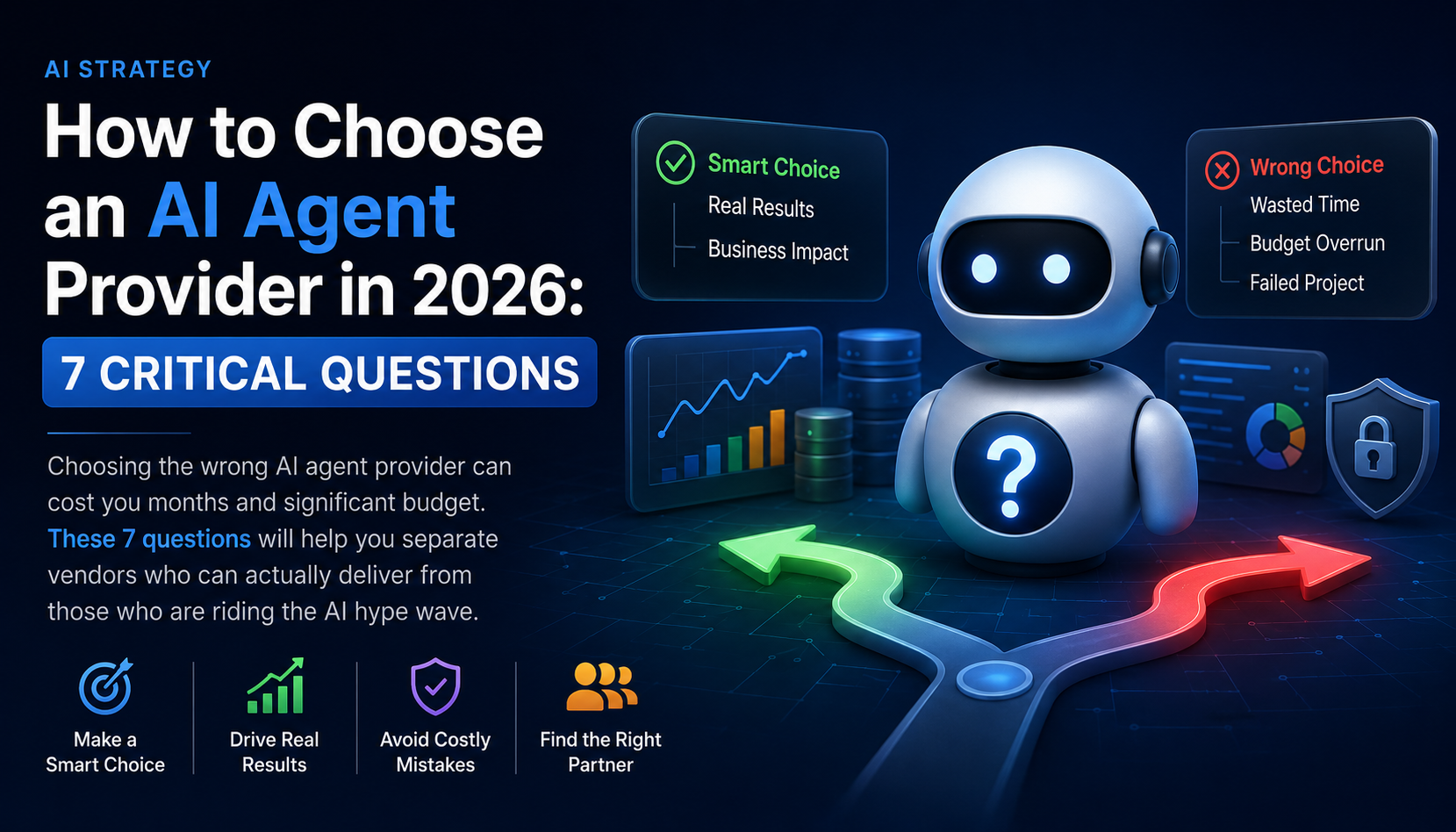
How to Choose an AI Agent Provider in 2026: 7 Critical Questions
Choosing the wrong AI agent provider can cost you months and significant budget. These 7 questions will help you separate vendors who can actually deliver from those who are riding the AI hype wave.
Why Choosing Wrong Is Expensive
The AI agent market has exploded. Every SaaS company, consultancy, and IT services firm now claims to offer AI agents. Some genuinely can — others are wrapping existing automation tools in a large language model call and calling it an AI agent. The difference between the two determines whether your project ships in 6 weeks or 6 months, and whether it performs in production or collapses under real-world edge cases.
A failed AI agent engagement doesn't just cost you money — it costs you internal credibility. When an AI initiative fails, leadership often concludes that "AI isn't ready yet" rather than "we chose the wrong provider." Getting this selection right is strategic, not just tactical.
These seven questions are designed to surface the difference between providers who can genuinely deliver and those who are selling capability they haven't actually built yet.
1. Do They Build Custom Agents or Resell Pre-Built Tools?
This is the most important question, and the answer changes everything downstream. There are three archetypes in the market:
Design and deploy AI agents from scratch against your specific workflow. Higher upfront scoping, but the agent is built for your exact process — not retrofitted into a template.
Implement pre-built AI agent platforms (like Intercom AI, Salesforce Agentforce, etc.) in your environment. Lower cost for standard use cases; limited flexibility for non-standard workflows.
Existing RPA or chatbot vendors who have rebranded their product as an "AI agent" after adding a GPT wrapper. Often lacks genuine reasoning, planning, and autonomous execution capabilities.
Neither custom builders nor platform implementors are inherently better — the right choice depends on your workflow complexity and budget. What you want to avoid is a labeller: a vendor selling you automation as agency. Ask to see a demo of an agent handling an edge case it wasn't explicitly programmed for. That's where labellers fail.
2. What Is Their Typical Deployment Timeline?
Any provider promising a fully production-ready AI agent in under two weeks is either building something trivially simple or setting you up for a disappointing handoff. Equally, a provider who can't commit to a production date within 8 weeks is likely to deliver a never-ending project.
Ask how many production deployments they have shipped in the last 12 months, and what their average time from kickoff to first production traffic was. Providers who have done it repeatedly can answer this precisely. Those who haven't will give vague ranges.
3. How Deep Is Their Integration Capability?
An AI agent that can't connect to your existing systems of record is a toy, not a business tool. Ask specifically: which CRMs have they integrated with? Which support platforms? Which ERPs? Can they integrate with custom internal APIs? What's their approach to data security during integration?
The best providers will immediately name specific integrations they've built (Salesforce, HubSpot, Zendesk, ServiceNow, SAP, NetSuite) and can describe the integration pattern — whether they use webhooks, OAuth, API polling, or message queues. If the answer is "we can integrate with anything," ask them to walk you through their integration process in detail. Specificity here separates real capability from marketing language.
4. Can They Show You Case Studies With Real Metrics?
Any provider worth hiring should be able to show you at least two to three production deployments with measurable outcomes. Not "client satisfaction" — actual operational metrics: tickets resolved per agent per day, lead response time reduction, cost per handled conversation, automation rate, error rate.
"We deployed an AI support agent for a 200-person B2B SaaS company. In the first 60 days, it handled 73% of inbound tickets without human intervention. Average resolution time dropped from 4 hours to 90 seconds. Support team headcount held flat while ticket volume grew 40%."
If a provider can't share specific metrics from past deployments — even in anonymised form — they either don't have production clients yet or their deployments didn't perform well enough to be cited.
5. How Do They Handle Edge Cases and Failures?
This is the question that separates mature AI agent providers from first-timers. In production, AI agents encounter inputs they weren't designed for constantly. What happens when they do?
Ask specifically: What is their escalation logic? When does the agent hand off to a human, and how is that handoff executed? How do they monitor for agent hallucinations or incorrect actions? What's their process for retraining or adjusting the agent after a failure in production? Do they have a human review queue for flagged interactions?
Providers who have shipped real agents will have detailed, specific answers to all of these. They'll probably proactively bring up the challenges they hit in past deployments. Providers who haven't will give you platitudes about "AI safety" and "responsible AI" without describing any actual mechanism.
6. What Does Post-Launch Support Look Like?
AI agents are not "deploy and forget" systems. They require ongoing prompt optimisation, knowledge base updates, performance monitoring, and periodic retraining as your business processes evolve. Ask exactly what's included in post-launch support and what costs extra.
Are they watching agent performance metrics, escalation rates, and error patterns — or does production visibility require you to build your own dashboard?
When the agent underperforms on a class of inputs, who adjusts the prompts and workflows — and what's the SLA for those changes?
How do you add new capabilities or workflows as the agent proves itself? Is this scoped per-project or part of an ongoing engagement?
7. What Is Their Pricing Structure?
AI agent pricing models vary significantly and the model matters as much as the number:
Fixed project pricing — you pay for a scoped deliverable. Good for well-defined initial deployments. Risk: scope creep leads to change orders.
Retainer model — monthly fee covering ongoing development, monitoring, and iteration. Good for teams who want continuous improvement rather than a one-time delivery. Risk: you need clear deliverables and KPIs to hold the provider accountable.
Usage-based — you pay per conversation or task handled. Good for variable-volume use cases. Risk: costs can spike unexpectedly if volume grows faster than expected.
Ask for an all-in cost estimate covering the first 6 months — including build, integration, testing, launch, and ongoing support. Hidden costs often appear in "additional API usage," "change requests," and "knowledge base maintenance." Get this scoped in writing before you sign.
Red Flags to Watch For
Any provider with real production deployments will offer references. If they decline, their agents may only exist in demo environments.
Providers who claim their AI agent handles any edge case without escalation are either lying or have never shipped a production deployment. Every mature AI agent has escalation logic.
If a provider is ready to give you a quote without a detailed discovery session about your workflows, data, and integration requirements, they're selling you a template, not a custom agent.
Clarify upfront: who owns the trained agent, the prompts, the knowledge base, and the integration code? Some providers retain IP rights to what they build. You want full ownership.
Talk to a Provider Who Can Answer All 7
CubixKraft builds custom AI agents for sales, support, operations, and voice — with production deployments, real metrics, and full IP transfer to clients. Our AI agent development process starts with a structured discovery session before any commitment.
Book a Free Discovery Call →