By CubixKraft Team
AI Agents vs RPA: Key Differences and Which One Your Business Actually Needs
Robotic Process Automation (RPA) and AI agents both promise to automate your business — but they do it in fundamentally different ways. Understanding the difference determines whether you buy a tool that solves today's problem or one that scales with your ambitions.
The Core Difference in One Sentence
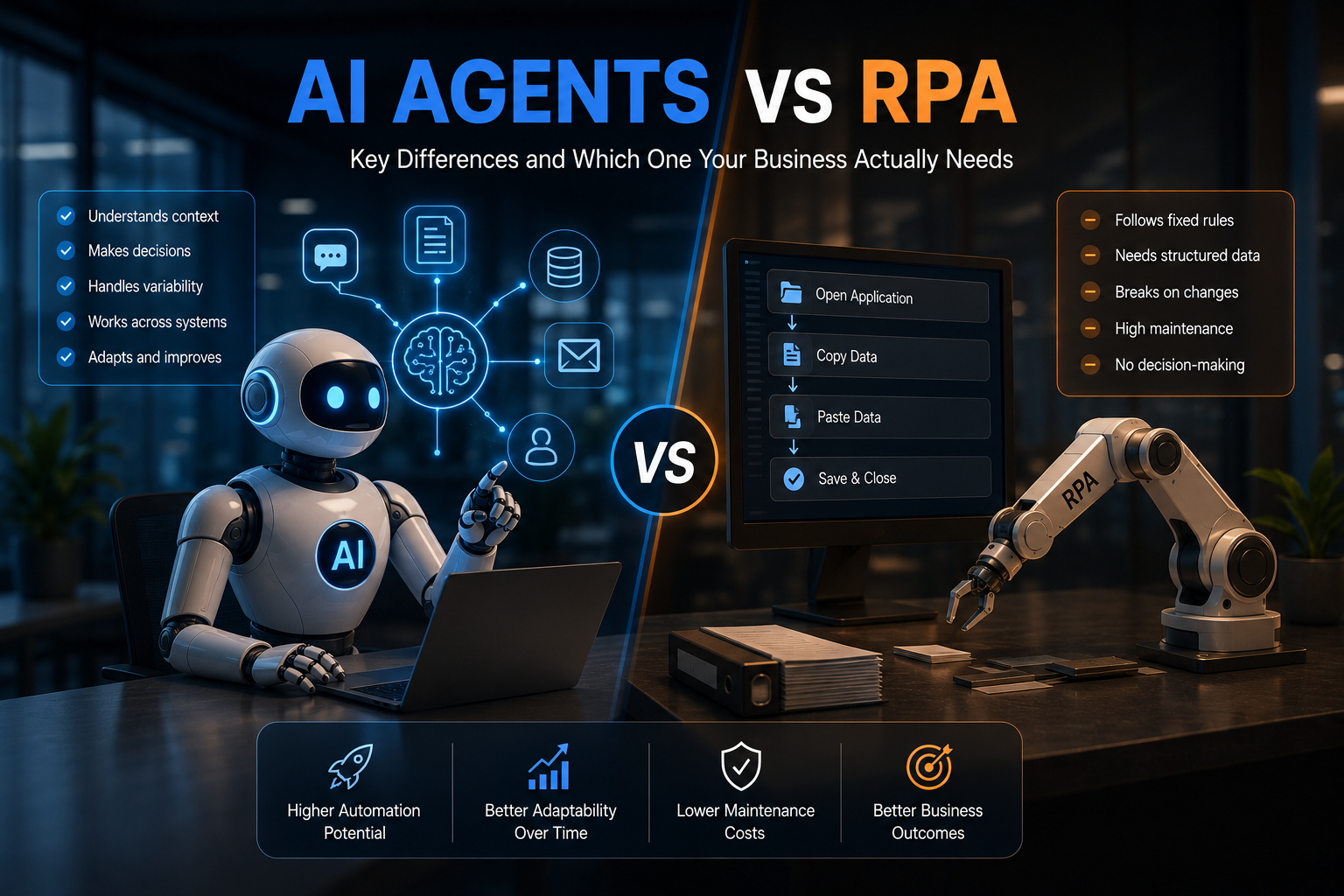
RPA mimics human clicks on existing software. AI agents understand context, make decisions, and act across your entire business stack — without a rigid script.
Choosing the wrong automation technology is expensive. RPA requires extensive maintenance every time your software interface changes. AI agents require different infrastructure upfront but adapt to change without constant re-scripting. The right choice depends on what you're automating — and how much variability it involves.
What Is RPA?
Robotic Process Automation (RPA) is software that records and replays human interactions with a computer interface. An RPA bot might:
- Open a browser, log into a portal, copy data, and paste it into a spreadsheet
- Extract data from a PDF and enter it into a CRM field
- Read an inbox, categorize emails by subject line, and move them to folders
- Generate a weekly report by pulling figures from multiple software dashboards
RPA works well when the inputs are structured (the same format every time), the process steps are fixed (no decision-making required), and the software interfaces are stable (buttons and fields don't move).
What Are AI Agents?
AI agents use a large language model to understand context and intent, then act across APIs, databases, and communication channels. An AI agent might:
- Read an unstructured email from a customer, understand the issue, look up the order in a CRM, and send a personalised resolution
- Qualify an inbound lead by asking contextual follow-up questions based on the prospect's industry and company size
- Monitor an operations dashboard, detect an anomaly, investigate root cause across multiple logs, and alert the right team with a summary
- Process an invoice — even in a non-standard format — extract key fields, verify against purchase orders, and approve or flag for review
AI agents handle variability. They don't require structured inputs. They don't break when an interface changes. They can make decisions, not just follow scripts.
RPA vs AI Agents: Direct Comparison
- Requires structured, consistent inputs
- Follows fixed, pre-defined rules
- Brittle — breaks when UI changes
- High maintenance cost over time
- No reasoning or decision-making
- Low upfront complexity
- Ideal for stable, repetitive back-office tasks
- Handles unstructured, variable inputs
- Reasons and adapts to novel situations
- Works via APIs — not fragile UI scraping
- Lower maintenance; adapts to change
- Makes decisions with defined guardrails
- Requires more careful design upfront
- Ideal for customer-facing and complex multi-step workflows
When RPA Is the Right Choice
RPA works well when you have:
- A stable legacy system with no API access (RPA can automate the UI instead)
- A completely uniform, structured process with zero variability
- A short-term automation need where investment in AI infrastructure isn't justified
- An IT team equipped to maintain RPA bots through ongoing interface changes
Classic RPA sweet spots: payroll data entry, ERP data migration, fixed-format report generation.
When AI Agents Are the Right Choice
AI agents are the right choice when you have:
- Unstructured inputs (emails, documents, customer messages, voice calls)
- Processes that require interpretation or decision-making
- Customer-facing workflows where quality and tone matter
- High-volume processes where you want 24/7 coverage
- A desire for systems that improve over time, not just maintain status quo
Can RPA and AI Agents Work Together?
Yes — and many mature automation programmes use both. A common pattern: AI agents handle the understanding and decision-making layer, while RPA bots handle data entry into legacy systems that have no API. The AI agent reasons about what should happen; the RPA bot executes the UI interaction in the legacy system.
This hybrid approach lets you automate end-to-end even when part of your stack doesn't have modern API access. But as a general principle: if a modern API alternative exists, prefer it over RPA. RPA on top of APIs is fragility layered on stability — always a worse choice.
The Verdict for Indian Businesses in 2026
If you are a growing business in India — ecommerce, SaaS, real estate, healthcare, manufacturing — and you're thinking about automation for the first time, AI agents give you a higher ceiling than RPA. You don't have the legacy infrastructure constraints that drove early RPA adoption in enterprises. You can build natively on modern APIs from the start.
RPA made sense in 2015 when enterprise software had no APIs and automation was a new idea. In 2026, for businesses building their first automation capability, AI agents are the better foundation.
Not Sure Which Is Right for You?
CubixKraft audits your current workflows and recommends the right automation approach — RPA, AI agents, or a hybrid — based on your actual business processes and systems.
Get a Free Workflow Audit →