AI Operations Agents to Run Your Business Smarter
Automate daily workflows without the complexity.
A lot of business time gets lost in repetitive operational tasks—updating data, managing workflows, coordinating between tools, and handling routine processes. With CubixKraft AI Operations Agents, you can automate these everyday tasks and keep your operations running smoothly—without constant manual effort.
These agents work quietly in the background, connecting systems, executing tasks, and helping your team focus on what actually matters.
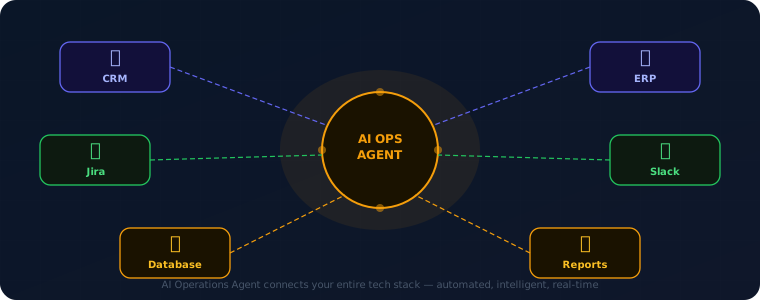
What are AI operations agents?
AI Operations Agents are intelligent systems designed to manage and automate business processes across tools, teams, and workflows. They can:
- Execute routine operational tasks
- Move data between systems automatically
- Trigger workflows based on conditions
- Monitor processes and flag issues
- Support decision-making with real-time insights
In simple terms—they help your business run more efficiently, with less manual intervention.
How CubixKraft AI operations agents help
- Automate repetitive tasks Reduce time spent on manual updates, reporting, and coordination.
- Connect your tools Integrate with CRM, ERP, and other platforms to keep everything in sync.
- Improve workflow efficiency Ensure tasks are completed faster and without errors.
- Real-time monitoring Track operations and get alerts when something needs attention.
- Scale operations easily Handle growing workloads without increasing operational overhead.
Where you can use AI operations agents
- Workflow automation across departments
- Data syncing between tools
- Task scheduling and execution
- Order and inventory management
- Internal process automation
- Reporting and performance tracking
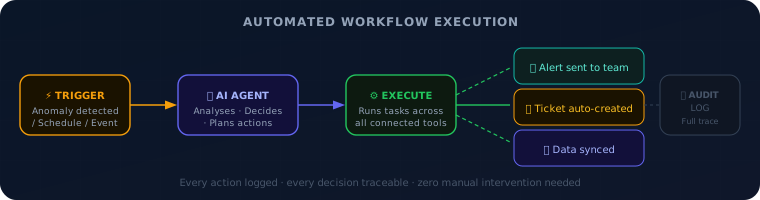
If your operations involve multiple tools and repetitive steps, AI can simplify the entire flow.
Why businesses choose CubixKraft
CubixKraft focuses on making AI automation practical for real-world operations.
- Custom workflows tailored to your business
- Seamless integration with existing systems
- Scalable for growing teams and processes
- Actionable insights for better decisions
It's not just automation—it's about building a more efficient and reliable operational system.
Ready to streamline your operations?
If you're looking to reduce manual work, improve efficiency, and scale operations smoothly, AI Operations Agents from CubixKraft can help you get there.
Automate the routine. Focus on growth. Run smarter.
Frequently Asked Questions
What is an AI operations agent?↓
An AI operations agent is an autonomous software agent that monitors your business systems, triggers workflows when specific conditions are met, coordinates between tools, and handles routine operational tasks — without human intervention. Think of it as a digital operations manager that never sleeps.
What types of workflows can an AI operations agent automate?↓
AI operations agents can automate data sync between platforms, notification and alert workflows, approval routing, report generation, onboarding sequences, inventory management alerts, SLA monitoring, and any process involving conditional logic across multiple systems.
How does the agent monitor systems and detect anomalies?↓
Operations agents connect to your data sources via APIs and webhooks, continuously evaluating incoming signals against defined thresholds. When an anomaly is detected — such as a spike in error rates or a missed SLA — the agent triggers an alert or automated response immediately.
What triggers an escalation to a human team member?↓
Escalation triggers are fully configurable. Common conditions include: anomalies outside expected parameters, decisions requiring human judgment, high-value transactions above a threshold, or explicit escalation requests. You maintain full control over when humans stay in the loop.
How does an AI operations agent integrate with our existing tools?↓
CubixKraft operations agents connect to your stack via REST APIs, webhooks, and native integrations — including Slack, Notion, Asana, Jira, Google Workspace, HubSpot, Salesforce, and custom internal databases. Integration architecture is designed during the scoping phase.