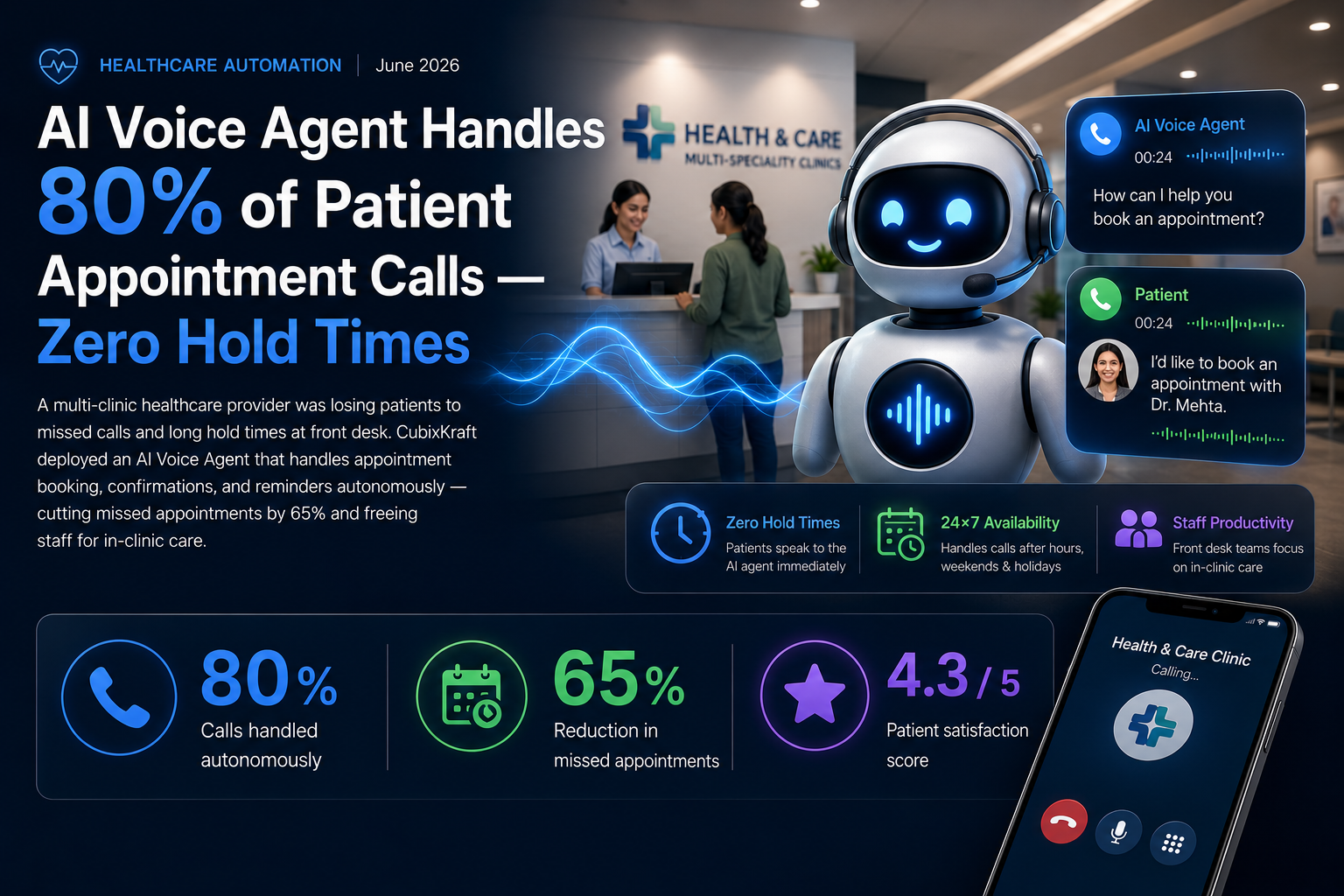
AI Voice Agent Handles 80% of Patient Appointment Calls — Zero Hold Times
A multi-clinic healthcare provider was losing patients to missed calls and long hold times at front desk. CubixKraft deployed an AI Voice Agent that handles appointment booking, confirmations, and reminders autonomously — cutting missed appointments by 65% and freeing staff for in-clinic care.
The Challenge
A healthcare provider operating five clinics across Rajkot and Ahmedabad was managing 300–400 patient calls per day across their front desk teams. Peak hours — 9–11am and 4–6pm — regularly resulted in hold times of 8–15 minutes, missed calls, and frustrated patients who simply called a competitor clinic.
Every missed call is a missed appointment. Every missed appointment is lost revenue and a patient who may not return. The front desk staff were burning out handling volume they structurally couldn't manage, and the clinic directors had no scalable way to add capacity without hiring more receptionists at every location.
Additionally, appointment reminder calls — a critical step in reducing no-shows — were inconsistently made because front desk staff prioritised incoming calls over outbound reminders. No-show rates were running at 18–22%, significantly above industry average.
The Solution: AI Voice Agent Deployment
CubixKraft deployed an AI Voice Agent integrated with the clinic's practice management system (appointment calendar, patient records, doctor availability). The agent handles the full patient call journey — inbound booking, rescheduling, cancellations, and outbound appointment reminders.
Patients call the clinic's existing phone number. The AI voice agent answers immediately, understands natural speech, identifies the patient, and books appointments against live doctor availability — without hold times.
The agent automatically calls every patient 48 hours and 2 hours before their appointment — confirming attendance, handling rescheduling requests, and filling cancelled slots from the waitlist.
Complex queries — insurance questions, medical record requests, complaints — are identified immediately and transferred to a human staff member with full call context.
The Results
Hold times dropped to zero for the 80% of calls handled by the AI agent. Front desk staff — previously overwhelmed with volume — now focus entirely on in-clinic patient experience and the 20% of calls that genuinely require human judgement.
The Workflow Architecture
- Patient calls the existing clinic phone number — no new number required
- AI voice agent answers immediately with a personalised greeting using the patient's name (pulled from the practice management system via caller ID)
- Natural language understanding identifies the call intent — new booking, reschedule, cancellation, query
- Appointment booking: agent checks live availability, books the slot, sends SMS confirmation
- Outbound reminders: automated calls at 48hr and 2hr marks with confirmation and rescheduling options
- Complex calls: transferred to human staff with a real-time summary of the patient and call context
Key Learnings
The most important design decision was the caller identification flow. Initially, we had patients spell out their name or date of birth to identify themselves — this created friction. We moved to caller-ID-based lookup with a simple confirmation step, which reduced call handling time by 40% and dramatically improved the patient experience.
The outbound reminder impact was larger than anticipated. A 65% reduction in no-shows at an average appointment value of ₹800–₹1,200 translated directly to significant monthly revenue recovery across the five clinics. The ROI from reminders alone justified the deployment cost within the first 45 days.
Want results like this for your business?
We'll analyze your workflows and show you exactly where AI agents can deliver measurable ROI.
Book a Free Strategy Call