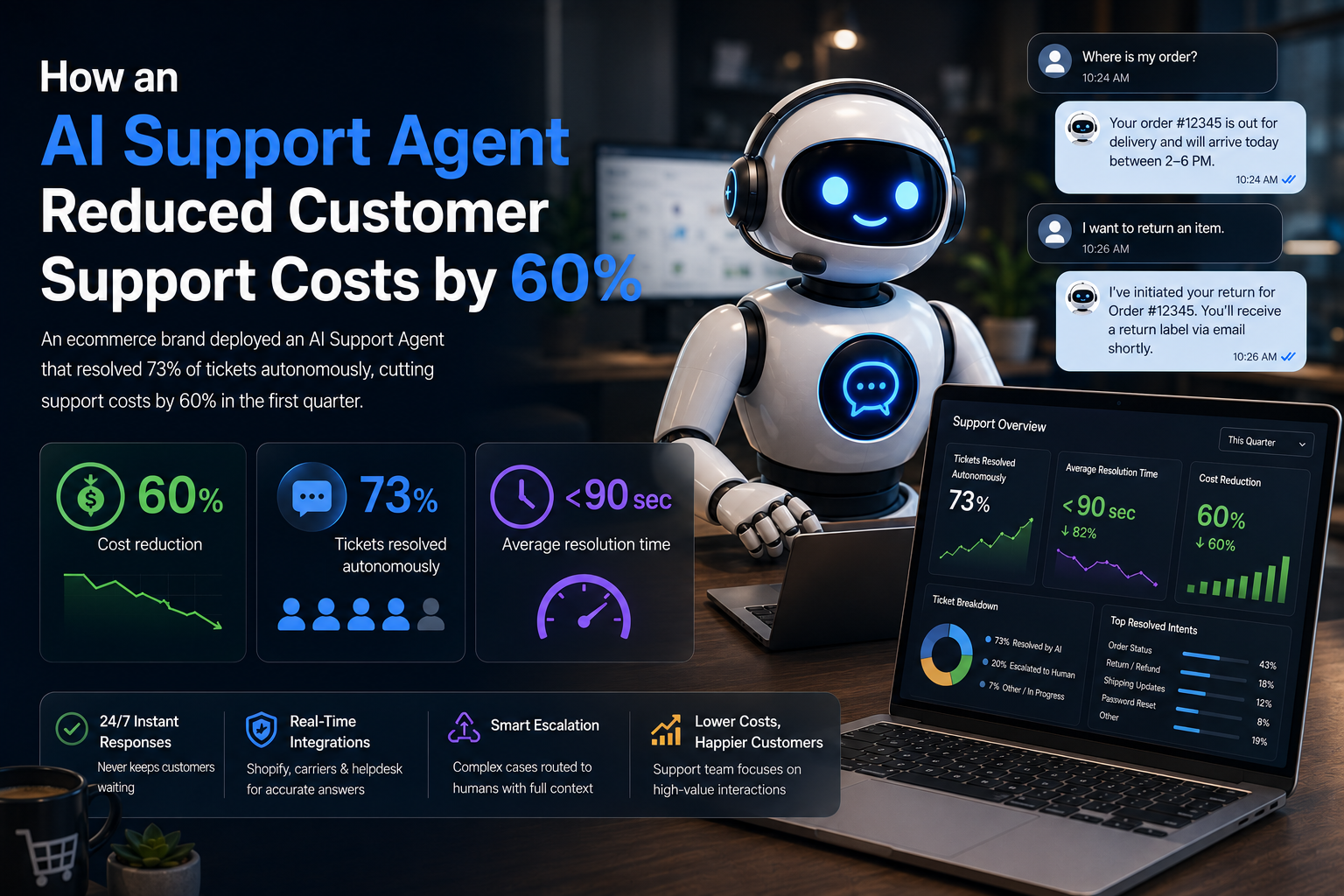
How an AI Support Agent Reduced Customer Support Costs by 60%
An ecommerce brand was drowning in repetitive support tickets — return status, shipping updates, password resets. CubixKraft deployed an AI Support Agent that resolved 73% of tickets autonomously, cutting support costs by 60% in the first quarter.
The Challenge
A fast-growing ecommerce brand was handling over 2,000 support tickets per day with a team of 8 agents. More than 70% of those tickets were routine — order status checks, return requests, shipping update queries, and password resets. The team was spending 80% of their time on low-value, repetitive work, and average response times had stretched to 6+ hours.
The team wasn't failing — the volume was just wrong for the headcount. Every repetitive ticket answered manually was a high-value ticket left waiting. Customer satisfaction scores were slipping as a result.
The Solution: AI Support Agent Deployment
CubixKraft designed and deployed an AI Support Agent integrated directly with their Shopify store, helpdesk (Zendesk), and shipping carrier APIs. The agent was trained on the brand's tone, return policy, and product catalog.
The agent reads every incoming ticket, classifies it by intent, and routes it — handling routine tickets autonomously and escalating complex cases to humans.
Real-time integration with Shopify and carrier APIs means the agent gives accurate, current answers about order status and delivery timelines.
Any ticket flagged as high-value, frustrated, or outside policy is immediately routed to a human agent with full conversation context.
The Results
The human team now handles only high-value, complex queries. Customer satisfaction scores improved, and the team was reallocated to proactive customer success work rather than reactive support.
The Workflow Architecture
The AI Support Agent operates as a fully integrated system — not just a chatbot layer:
- Inbound ticket arrives via email, chat, or portal
- Agent classifies intent using NLP (return, order status, complaint, billing, etc.)
- For routine tickets: agent queries the relevant API, generates a response, sends it, and closes the ticket
- For edge cases: agent prepares a summary with context and escalates to a human agent in Zendesk
- All actions are logged for audit, QA review, and continuous improvement
Key Learnings
The most important design decision was the escalation threshold. Early in the project, we set escalation too conservatively — the agent escalated 45% of tickets. After two weeks of reviewing escalated tickets, we identified clear patterns and updated the agent's decision logic. Within 30 days, autonomous resolution reached 73% while maintaining quality.
The second key insight: the agent performs best when it has access to real-time data. Static FAQ-based bots plateau quickly. This agent improves continuously because it's connected to live systems.
Want results like this for your business?
We'll analyze your workflows and show you exactly where AI agents can deliver measurable ROI.
Book a Free Strategy Call