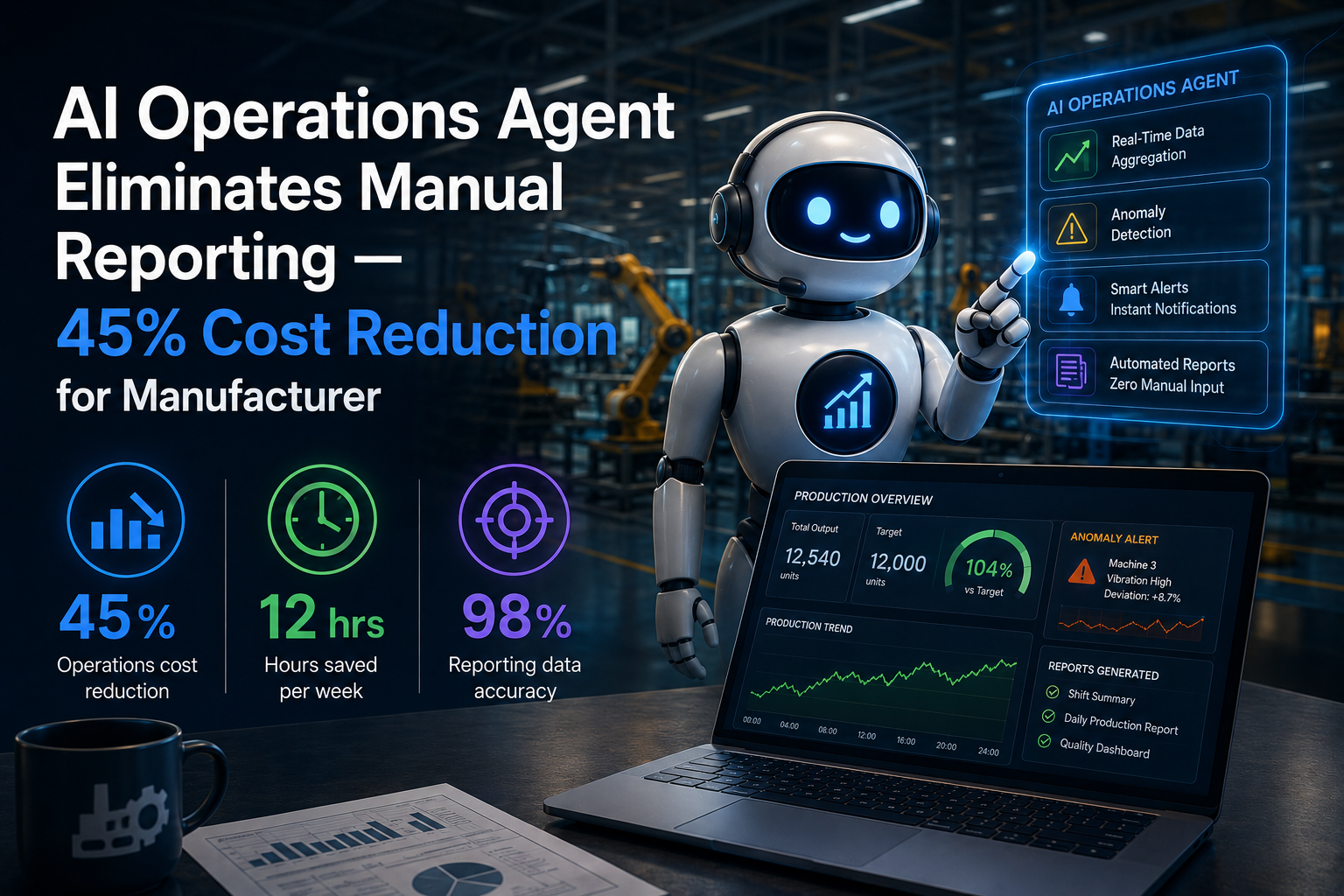
AI Operations Agent Eliminates Manual Reporting — 45% Cost Reduction for Manufacturer
A mid-size manufacturing firm was losing 12+ hours per week to manual production reports pulled from three disconnected systems. CubixKraft deployed an AI Operations Agent that now runs every report automatically, flags anomalies in real time, and alerts the right people — with zero manual input.
The Challenge
A 200-person manufacturing company in Gujarat was operating three separate systems — an ERP for production planning, a standalone machine monitoring tool, and a spreadsheet-based quality control log maintained by shift supervisors. Every morning, the operations manager manually pulled data from all three, reconciled discrepancies, and assembled a daily production report. On a good day, this took 2 hours. On a complex day, it took the entire morning.
It wasn't just the 2 hours per day — it was that the report was always 2–4 hours old by the time decisions were made from it. Production line issues that could have been caught at 8am weren't flagged until the 10am report was assembled and reviewed. By then, the defective batch had already moved downstream.
Across the full team, manual data collection and reporting was consuming 12+ hours per week of senior operations time — time that could have been spent on process improvement, supplier management, or quality initiatives.
The Solution: AI Operations Agent
CubixKraft designed an AI Operations Agent that connects directly to all three data sources — the ERP, the machine monitoring API, and the quality log (migrated to a structured database as part of the engagement). The agent runs continuously, not on a schedule.
The agent pulls live data from the ERP, machine sensors, and quality logs — reconciling and normalising it into a single operational view without any human involvement.
When production output deviates from target by more than 5%, or a machine metric crosses a threshold, the agent flags it immediately and sends a structured alert to the relevant supervisor via WhatsApp and email.
Shift summaries, daily production reports, and weekly quality dashboards are generated and distributed automatically — with zero manual input from the operations team.
The Results
The operations manager now receives a structured daily briefing at 6:30am — before they even reach the factory floor. Anomaly alerts mean issues are addressed within minutes of occurring, not hours. The team has reclaimed 12+ hours per week for higher-value work.
The Workflow Architecture
- Continuous data polling from ERP, machine monitoring API, and quality database every 5 minutes
- Normalisation layer reconciles unit formats, timestamps, and naming conventions across systems
- Anomaly detection engine flags deviations against configurable thresholds per metric
- Alert routing sends WhatsApp + email notifications to relevant supervisor based on alert type
- Scheduled report generation at shift end, day end, and week end — distributed automatically to the team
- Full audit log of all data points, calculations, and decisions for compliance purposes
Key Learnings
The biggest technical challenge was the quality log — it had been maintained in a free-form spreadsheet for 3 years, with inconsistent formats across different supervisors. Two weeks of the engagement were spent structuring this data before the agent could connect to it. The lesson: data cleanup is not a distraction from an AI project — it's part of the project.
The most valuable unexpected outcome was the anomaly detection capability. The company had not originally asked for it — they just wanted automated reporting. But once the agent was connected to live machine data, real-time anomaly alerting became a natural extension. In the first month, it caught two production line issues that would previously have taken a full shift to identify.
Want results like this for your business?
We'll analyze your workflows and show you exactly where AI agents can deliver measurable ROI.
Book a Free Strategy Call